
Union Home Minister P Chidambaram on Friday said recommendations of two panels on replacing the controversial Armed Forces (Special Powers) Act, in force in some northeastern states, with a more humane law would soon be placed before the Cabinet.

Irom Sharmila, Manipur's 'Iron Lady', on Monday completed 12 years of indefinite fast demanding repeal of the Armed Forces Special Powers Act.
'She feels that undertaking the fast is what she is meant to do in life. She believes deeply that that's her purpose, and that's what God wants her to do,' says Deepti Priya Mehrotra, the author of Burning Bright: Irom Sharmila and the Struggle for Peace in Manipur.
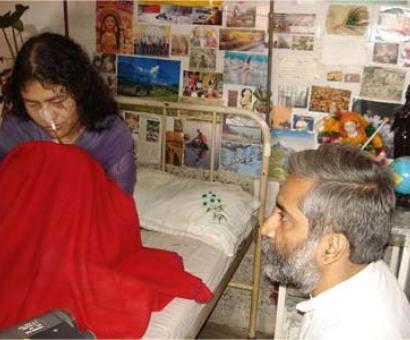
Irom Sharmila with Magsaysay Award winner Sandeep Pandey.
Hundreds of protestors demanding full withdrawal of the act from the state pelted stones and destroyed a bus at Singjamei area, near Imphal.

'The next two to three weeks will not be decided in Washington.' 'They will be decided in Tehran, in whatever calculation Iran makes about the costs of continued resistance against the costs of appearing to have yielded.'
Jammu and Kashmir, chief minister, Omar Abdullah assured the state assembly on Thursday that he will repeal the Armed Forces Special Powers Act and Disturbed Areas Act 'if the situation continued to improve' in Kashmir.

Irom Sharmila, has been fasting for 9 years against a controversial law.

Jammu and Kashmir Chief Minister Omar Abdullah on Wednesday said he would raise the issues of partial revocation of Armed Forces Special Powers Act (AFSPA) during the next internal security meeting in Delhi.
The time is 'not right' for the removal of the Armed Forces Special Powers Act from Jammu and Kashmir, Army Chief Gen Bikram Singh said on Friday, emphasising that any decision on this 'should not be politicised'.
Terming the situation in Jammu and Kashmir as "alarming", Bharatiya Janata Party leader L K Advani said the state administration had "completely collapsed" and the United Progressive Alliance government was about to "capitulate" before Pakistan- supported secessionists.
Warning that partial revocation of the Armed Forces Special Powers Act from Jammu and Kashmir will create "terrorist sanctuaries", Army chief General V K Singh has said dilution of the controversial Act will be 'detrimental' to national interest. the Army chief said, "Just one summer of peace does not mean normalcy. Diluting of AFSPA in any form will be detrimental to national interest."

The question is no longer whether the war will expand. It has. The next few days will tell us whether the war stabilises around Hormuz or whether the Strait itself becomes the trigger for a far larger rupture. What to watch for over the next 48 hours is simple: Any move by the US toward direct naval control of the Strait; any credible Iranian attempt to disrupt or mine shipping lanes and, critically, whether energy infrastructure in the Gulf continues to be targeted.If those lines are crossed in tandem, the war will no longer be containable within the region.
Home Minister P Chidambaram on Wednesday said the efforts of Jammu and Kashmir Chief Minister Omar Abdullah are to denotify the Disturbed Areas from some places in the state, a move which will pave way for removal of Armed Forces Special Powers Act.
Supporting Omar Abdullah's demand for withdrawal of Armed Forces Special Powers Act from some areas of Jammu and Kashmir, Union Minister Farooq Abdullah on Thursday said the chief minister is "the boss" in the state and the Centre should take his views on the controversial Act.
Amid renewed demands for repeal of the Armed Forces Special Powers Act by Jammu and Kashmir Chief Minister Omar Abdullah, National Conference's alliance partner Congress on Wednesday said the time was not right for it and rejected the contention that the central government was being blackmailed by army on this.
A Delhi court on Monday framed charges against Irom Sharmila Chanu, who has been on fast for about 12 years demanding repeal of controversial Armed Forces Special Powers Act, for allegedly attempting to commit suicide during her 'fast until death' in the national capital in 2006.
Manipur experienced a year of intense turmoil in 2024, marked by escalating violence, displacement, and deepening divisions between the Meitei community in the valley and the Kuki tribes in the hills. The conflict, rooted in historical grievances and fueled by political tensions, resulted in numerous casualties, mob attacks, and drone strikes on civilian areas. The situation has led to widespread displacement, fear, and a sense of insecurity among the affected communities, with no signs of peace in sight.
The ruling National Conference President and Union Minister for New and Renewable Energy, Dr Farooq Abdullah on Thursday asked his party spokesman Dr Mustaffa Kamal "to exercise restraint and follow the party policy line on all issues, particularly those pertaining to the policies of the coalition government, relationship with the Congress party, Armed Forces Special Powers Act (AFSPA) and the role of the army".
"The presence of troops in residential areas is a grave threat... the sooner the rulers understand this, the better," Mirwaiz said addressing a religious function at Reshi Mohalla locality of Habbakadal in downtown city, shortly after authorities lifted restrictions on his movement.
Army Chief Gen Bikram Singh on Monday opposed any dilution of the Armed Forces Special Powers Act in Jammu and Kashmir, saying any decision to revoke it from any part should be taken only after getting inputs from security agencies and stakeholders.
Union Defence Minister A K Antony on Friday said that two army divisions, comprising around 30,000 troops, have been moved out of Jammu and Kashmir due to improvement in the situation there.
'She feels that undertaking the fast is what she is meant to do in life. She believes deeply that that's her purpose, and that's what God wants her to do,' says Deepti Priya Mehrotra, the author of Burning Bright: Irom Sharmila and the Struggle for Peace in Manipur.
Describing India as a "vibrant electoral democracy with an abysmal human rights record", a prominent international group on Moday urged to take steps to check rights violation by its security forces. The Human Rights Watch (HRW) also asked the country to remove all "immunity clauses" in its laws that protect abusers of human rights.
The solution to Manipur's problems lies in the government giving concessions to Meitis in jobs and education and to accept autonomy for the tribal dominated areas inhibited by the Kukis, suggests Colonel Anil A Athale (retd).
The People's Democratic Party on Sunday pledged 'absolute support to create an atmosphere conducive to initiate a serious effort for the resolution of Kashmir problem'.Addressing a public meeting in Jammu, PDP patron Mufti Mohammad Sayeed spelled out four conditions 'for creation of a conducive atmosphere'. "Release of political prisoners as well as hundreds of innocent youth languishing in different jails is a must," he said.
The AFSPA was being "unnecessarily demonised" although it had "nothing to do with the present unrest (in Kashmir)", General Singh said while firmly sticking to his opposition to any withdrawal or even dilution of the Act which gives the Army vast powers to deal with insurgents.
Abdullah, who had meetings with Prime Minister Manmohan Singh and Home Minister P Chidambaram in New Delhi on Monday, said he had raised the issue of withdrawal of the controversial Armed Forces Special Powers Act in a phased manner.
The People's Democratic Party leader Mufti Mohammad Sayeed on Monday asked Prime Minister Manmohan Singh to take urgent steps for revoking the Armed Forces Special Powers Act and withdrawing security forces from internal security duty in the Jammu and Kashmir.
The latter have been demanding withdrawal of the Armed Forces Special Powers Act citing atrocities by security forces.
The 32 organisations spearheading the stir against AFSPA have separately called a 14-hour Manipur valley bandh.
What everybody is losing sight of is the emergence of a new extremist segment in Kashmir which has taken advantage of the situation. This segment is now orchestrating events in a manner that suits their masters across the border.
In the first part of this interview with Bula Singh, former home secretary G K Pillai had talked about why AFSPA need not be repealed immediately but the Disturbed Areas Act should be lifted in Kashmir. In the second and concluding part of the interview, he explains that no one wants to take a risk or bite the proverbial bullet in Kashmir, fearing that the situation might implode again.
Three decades after it was imposed in Manipur to deal with insurgents, the controversial Armed Forces Special Powers Act (AFSPA) is still an issue used by parties during electioneering for the January 28 assembly poll in the state.

In an exclusive interview to CNN-IBN's Senior Editor Suhasini Haider, Jammu and Kashmir Chief Minister Omar Abdullah admits the lapses in the rehabilitation policy for surrendered militants following the fiasco over the arrest of Hizbul Mujahideen terrorist Liaqat Ali Shah.

Activist Irom Sharmila Chanu, who has been on fast for more than 12 years demanding repeal of the 'draconian' Armed Forces Special Powers Act from Manipur, was re-arrested by state police, officials said on Thursday.
Manipur Chief Minister Okram Ibobi Singh has warned citizens of the state that the Centre might re-impose the Armed Forces Special Power Act in the Imphal municipal area if the different underground outfits continue to unleash their reign of terror in the city.Describing the sharply deteriorated law and order situation in Manipur, the chief minister pointed out that "killing, extortion, hurling of grenade and bombs are happening at regular intervals," he said.
Intelligence inputs received by various army formations in Jammu and Kashmir appear to suggest that infiltration is on the rise after the state government's move for a partial withdrawal of Armed Forces Special Powers Act.
Amid a raging debate over AFSPA, a focused internal political dialogue must be launched in Kashmir to reassure the army that yet another hard-won peace will not be squandered by political lethargy, writes Ajai Shukla
